
Fireplace TV Mounting in Birmingham, Alabama
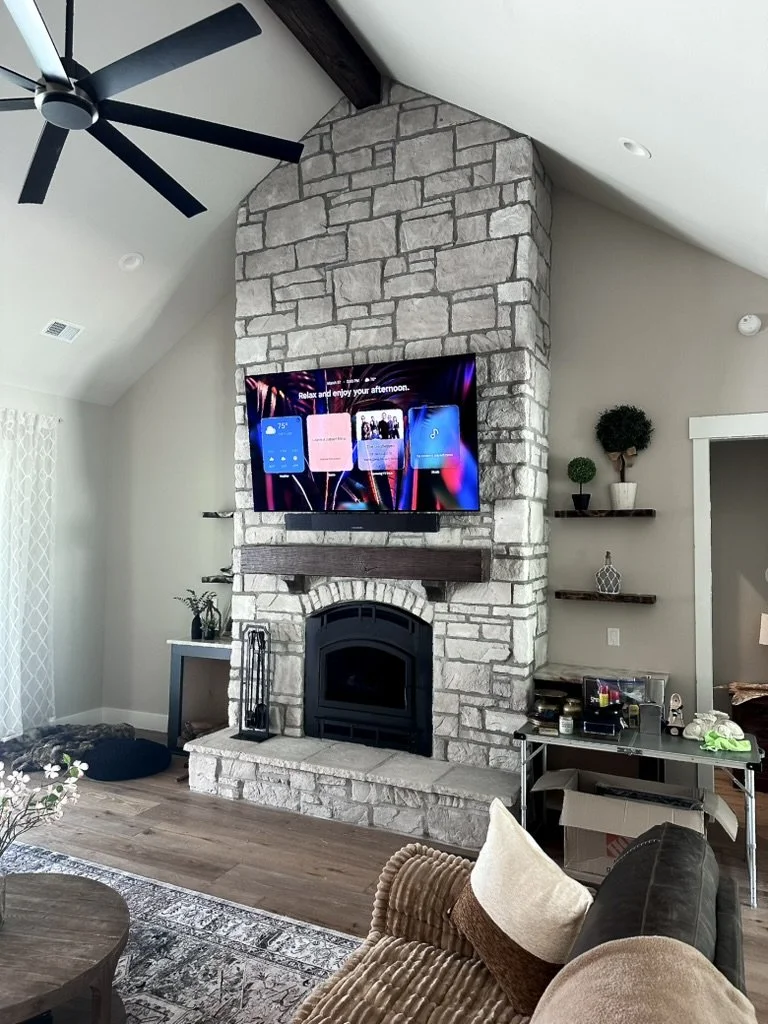
Most fireplace TV mounts in Birmingham are mounted too high, mounted incorrectly for the surround material, and have wires running down the side of a $20,000 stone fireplace. The TV ends up causing neck pain after 20 minutes of viewing, the surround develops cracks around poorly-anchored hardware, and the room looks worse than it did before — except now there's a TV in it.
Mounting a TV over a fireplace is genuinely the trickiest install in residential A/V. There are three real problems that don't exist with any other mounting job — heat from the fireplace, viewing height that's almost always too high, and surround materials (brick, stone, marble, tile) that aren't drywall and don't accept standard hardware. Get any of the three wrong and you've spent $500 to ruin a $20,000 fireplace.
We do this install every week. Iron City A/V is a home theater store and audio visual consultant in Birmingham. We mount TVs over fireplaces across Mountain Brook, Vestavia Hills, Crestline, Forest Park, Homewood, Hoover, Greystone, Liberty Park, and the Birmingham metro — brick, stone, marble, tile, drywall, all of them. This page covers what makes fireplace mounting different, how we solve the three real problems, and what it costs to do this right.
Should You Even Mount a TV Over Your Fireplace?
Honest answer first: not always.
If your fireplace is the only good wall in the room for a TV, mounting it there is usually the right call — and we can solve the height and heat problems with the right approach. Almost every Birmingham family room with a centered fireplace falls into this category.
If you have an alternate wall that works for the TV, mounting it there usually beats the fireplace. Side walls, the wall opposite the fireplace, custom built-ins flanking the fireplace — all are easier installs and avoid the height issue entirely.
If you're remodeling and the fireplace placement is still up for grabs, ask your designer to consider an off-center fireplace with the TV on the main wall instead. Best of both worlds.
We tell customers this honestly during the consultation. About a third of customers who call us about fireplace mounts walk away with a different plan after we look at the room. The other two thirds do mount over the fireplace — and we make that install right.
The Three Real Problems and How We Solve Them
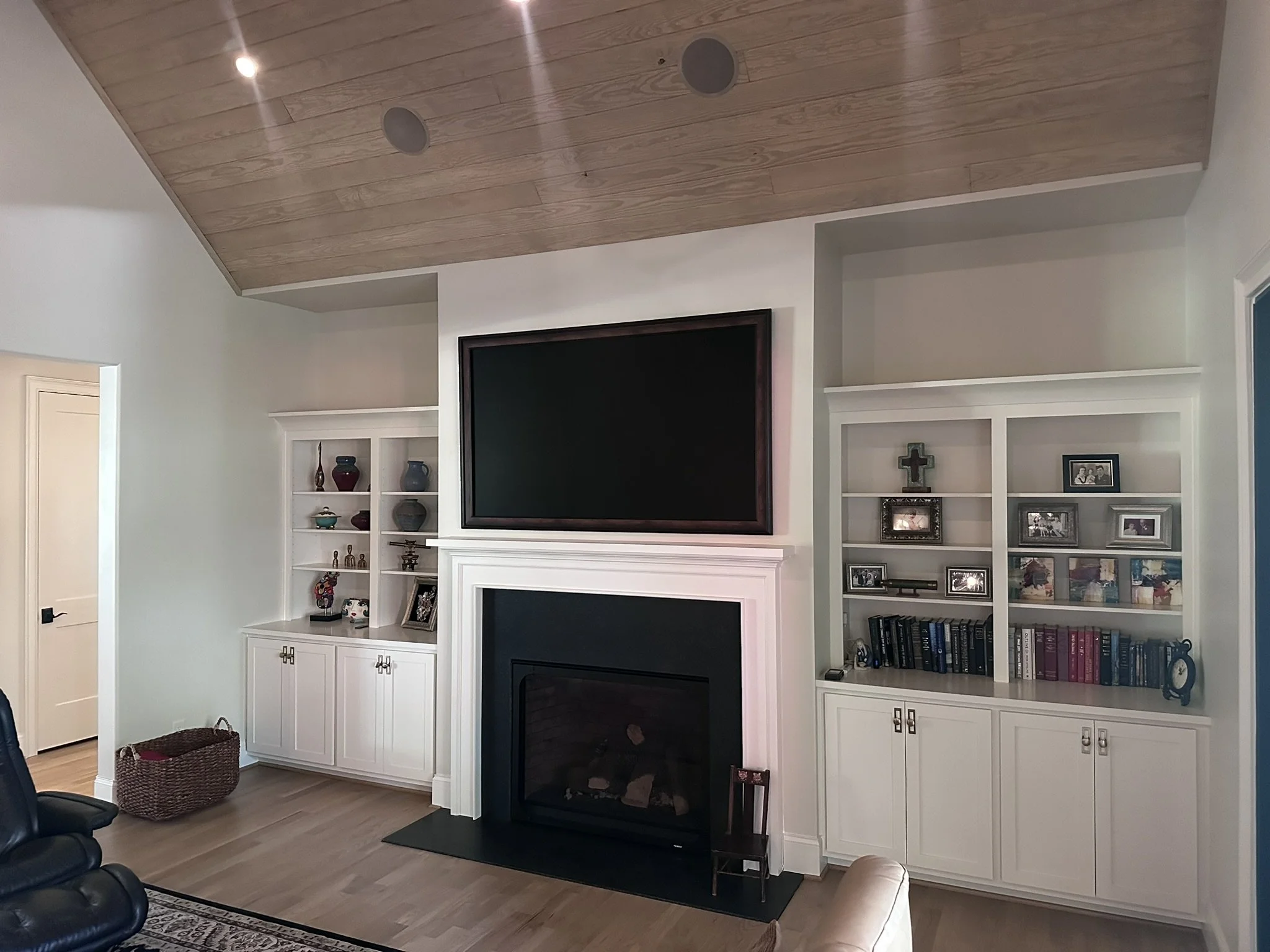
Problem 1: Heat
This is the one nobody talks about until it kills the TV.
Gas fireplaces — especially ventless gas logs and modern direct-vent units common in Greystone and Liberty Park new construction — produce significant radiant heat that rises directly up the surround to the TV mount location. Sustained heat above 95°F damages TV electronics over time. A TV mounted three feet above a regularly-used gas fireplace can fail in 2 to 3 years from heat alone, and the manufacturer's warranty doesn't cover it.
Wood-burning fireplaces produce even more heat at peak — but most modern Birmingham homes use them rarely. Electric fireplaces produce essentially no heat (the flame is decorative LED). Gas log fireplaces in older Mountain Brook and Crestline homes are somewhere in between depending on the unit.
How we solve it:
Site measurement during consultation. We measure the temperature at the proposed TV location with the fireplace running for 30 minutes. If it exceeds 95°F sustained, we have a problem to solve.
Mantel and surround as heat shields. A proper mantel that protrudes 8+ inches and a surround that extends well above the firebox redirect heat outward instead of straight up. Many older Birmingham fireplaces already have this; many modern minimalist surrounds don't.
Heat shields when needed. When the surround doesn't naturally redirect heat, we add a low-profile heat deflector above the firebox.
Mount selection. Some pull-down mounts (specifically MantelMount) move the TV away from the heat path entirely when in use.
Honest conversation about fireplace use. If you use a gas fireplace 3 hours every winter evening, the TV needs the full heat-management treatment. If you have a fireplace you've used twice in the past five years, the heat conversation is academic.
Problem 2: Viewing Height
Most fireplace TVs end up mounted at 60 to 72 inches above the floor — way above the ergonomic ideal of 42 to 48 inches for seated viewing. The result is neck strain after 20 minutes, an unpleasant viewing experience, and a TV that nobody actually wants to watch.
How we solve it:
MantelMount pull-down systems. A counterbalanced mount that lets the TV pull down 25 to 30 inches and tilt 30 to 45 degrees toward the viewer. When in use, the TV is at proper eye height. When the TV is off, it pushes back up flush against the surround. We're an authorized MantelMount installer — this is the single most-recommended fireplace mount we sell. Models we install most: MM340 (TVs up to 65"), MM540 (up to 80"), MM700 (up to 90"+).
Aggressive tilt mounts. When MantelMount isn't the right call (cost, surround geometry, or aesthetic preference), a heavy-tilt mount (Sanus VLT, similar) can angle the screen down toward the seating to compensate for some of the height issue. Better than a flat mount, not as good as a pull-down.
Motorized lifts and drop-down mounts. Future Automation makes powered ceiling-drop and wall-rotation mounts that pull the TV down on a motor. Reference-class solution for high-end builds where the customer wants the TV completely out of sight when off.
Lower the TV by lowering the mount. When the surround and mantel allow, mounting the TV lower on the surround (instead of above the mantel) can sometimes solve the height issue without specialty hardware. We figure out during the consultation whether your surround allows this.
The wrong answer is "mount it high and live with it." That's how most fireplace TVs end up unused.
Problem 3: Surround Materials
The wall above your fireplace is rarely drywall, and standard hardware doesn't work in the materials it actually is. Birmingham fireplaces come in roughly six surround types, each with its own install considerations.
Brick. Most common in Birmingham — Mountain Brook, Crestline, Forest Park, Vestavia, and Homewood traditional homes are full of brick fireplaces. Older brick (1920s-1960s) is often softer and easier to drill but more prone to chipping. Newer brick (post-1980) is harder and requires sharper bits. We use a hammer drill, masonry-rated anchors (Tapcons or expansion anchors depending on load), and patience. Drilling into a 100-year-old Mountain Brook brick fireplace is a one-shot situation — we mark twice, drill once.
Stone. Common in Greystone, Liberty Park, and high-end Mountain Brook builds. Tennessee fieldstone, Alabama limestone, and granite veneer are the most common varieties we see. Stone is harder to drill than brick, more variable in density (one stone in the surround can be limestone, the next granite), and any error shows. We pre-survey the stones to find the best mounting positions.
Marble. High-end Mountain Brook and Inverness homes often feature marble surrounds. Drilling marble cleanly requires diamond bits, water cooling, and slow drilling speed. Cracked marble is unrepairable — we work very slowly here.
Tile. Often the surround material above mantels in newer construction. Tile cracks easily if drilled wrong, but cleanly with a diamond bit and proper technique.
Wood mantel and drywall above. A common configuration — wood mantel at the bottom of the surround, drywall above it. The drywall section above the mantel is the easy install scenario; we find the studs behind and lag-bolt as normal. The catch is that fireplaces don't always have studs in the convenient location, so blocking sometimes has to be added.
Stucco and plaster. Rare in Birmingham fireplaces but does come up in Spanish and Mediterranean style homes. Treated similarly to brick — masonry approach with extra patching tools.
The right hardware for the surround is critical. We bring drill bits and anchors for every common Birmingham material to the install — there's no "we'll come back tomorrow with the right bit" with us.
Cable Concealment Over a Fireplace
Fireplace TV cable concealment is harder than standard wall mounting because the wall isn't drywall and you can't run a cord through it the same way.
Three approaches we use:
Through-wall power above the mantel (preferred). When there's drywall above the mantel and the surround is brick or stone only at the lower section, we run a code-compliant in-wall power kit through the drywall section. Cleanest result.
Around the fireplace surround. When the entire wall is brick or stone, we run cable in conduit or in a thin cable channel painted to match the surround color. Less invisible than through-wall but neat and professional.
Through the firebox interior or hearth (occasionally). In specialized installs we run cable through unused chase space adjacent to the firebox. Code-compliant only when done carefully and with appropriate fire-rated materials. Not common but sometimes the right answer in older masonry fireplaces with chase space.
Pre-installed wiring (new construction). When we work with builders on Greystone, Liberty Park, or new Mountain Brook homes during framing, we pre-run the cabling and the fireplace surround gets installed around it. Cheapest time to handle this is before the fireplace is built — but most customers are dealing with existing fireplaces.
What we don't do: run a cord down the front of a stone fireplace and call it done. That's the most common installation failure we see when we're called in to fix someone else's work.
If You Need a New TV Too
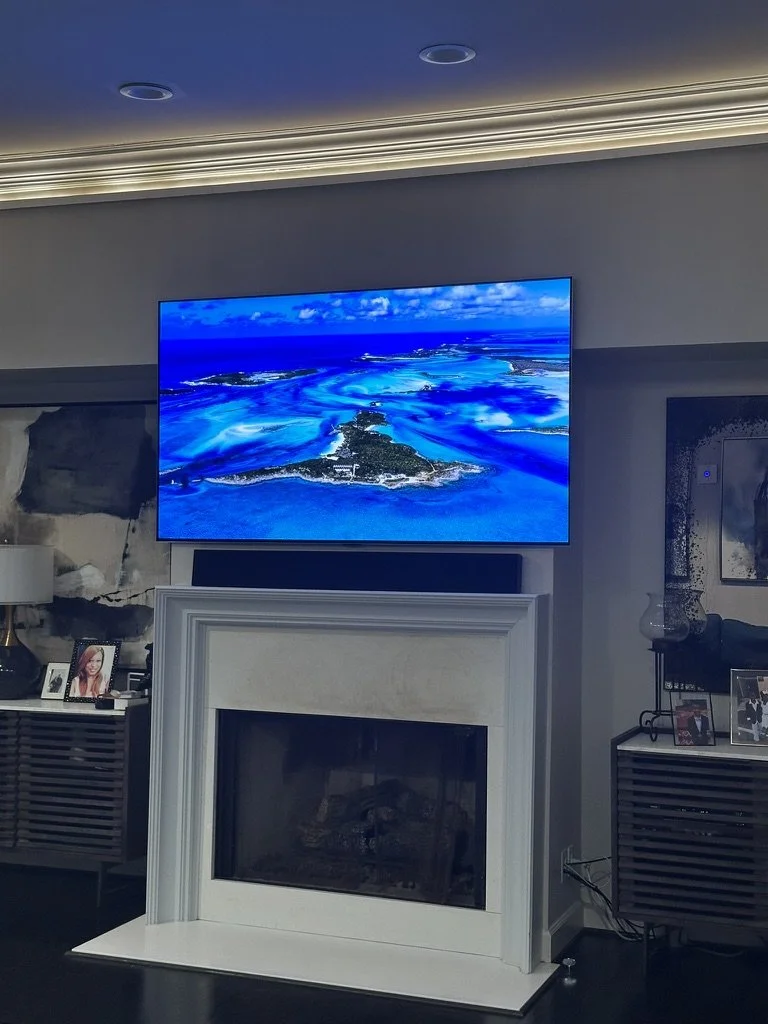
Iron City A/V sells Samsung, LG, and Sony TVs. For fireplace mounts specifically, we typically recommend OLEDs (LG and Sony) for the dedicated viewing experience or Samsung's anti-glare matte-finish models when the room has bright windows opposite the fireplace. Sizes from 55 to 85 inches work for most fireplace installs — over 85 inches usually requires a wider surround than the typical Birmingham fireplace allows.
If you're upgrading the TV at the same time as the fireplace mount, we'll bring options to the consultation, talk through which model fits your room and your fireplace surround, and handle the TV purchase, the MantelMount or specialty mount install, and the cable concealment in one project.
What to Expect From the Process
A typical fireplace TV install in Birmingham runs through four steps:
Consultation. We come to the house, look at the fireplace, measure the surround, identify the material, check sun exposure on the screen position, and (if the fireplace is gas or wood-burning) measure heat output during a 30-minute test run. About 90 minutes — longer than a typical TV mount consultation because there's more to look at.
Recommendation and proposal. Within a few days, you get a written proposal with the mount selection (with reasoning for MantelMount vs. tilt vs. specialty motorized), the cable concealment plan, any heat-management additions, the TV if you're upgrading, and the install in a fixed price.
Install. Most fireplace mounts run 4 to 8 hours onsite. Brick, stone, and marble installs take longer than drywall installs. Cable concealment adds time. MantelMount installs are slightly more complex than standard mounts.
Setup and walkthrough. TV calibration, source connection, mount operation walkthrough (especially important with MantelMount — the counterbalance has to be tuned to the actual TV weight), and a discussion of when to use the pull-down vs. when to leave it up.
Most fireplace TV installs go from signed contract to finished install inside 2 to 3 weeks. Specialty motorized mounts (Future Automation lift systems, custom hidden installs) take 4 to 8 weeks because the equipment is built to order.
What Fireplace TV Mounting Costs in Birmingham
Real ranges, mount and install:
Standard fireplace mount on drywall above mantel: $800 to $1,500. Drywall section above wood mantel, standard heavy-tilt mount, in-wall power kit, cable concealment, basic setup. The simplest fireplace install.
Brick or stone fireplace mount: $1,200 to $2,500. Masonry drilling, surface conduit for cables (or through-wall when feasible), tilt mount or basic MantelMount, full install.
MantelMount fireplace install: $1,800 to $3,500. MantelMount specialty mount (MM340, MM540, or MM700 depending on TV size), masonry mounting on brick or stone, full cable concealment, counterbalance tuning, walkthrough. The most-recommended option for serious Birmingham fireplace TVs.
Specialty motorized fireplace install: $3,500 to $10,000+. Future Automation motorized lift, custom millwork integration, full hidden install when the TV is off. Reference-class solution for high-end builds.
Marble or specialty surround installs: Add $300 to $800 to any of the above for the additional drilling and finishing care marble and high-end stone require.
These numbers cover the mount, the hardware, the cabling, the install, and the setup. They don't cover modifying the fireplace itself, adding new electrical circuits, or major surround repair if the existing surround has structural issues. If the TV is being purchased through us, that's a separate line item discussed during the consultation.
FAQs About Fireplace TV Mounting in Birmingham
Won't the heat from my fireplace damage the TV?
It can, depending on the fireplace type and how often it's used. Gas fireplaces (especially ventless and direct-vent units) produce real heat that rises to the TV mount location. Wood-burning is even hotter at peak. Electric fireplaces produce essentially no heat. We measure heat output at the TV location during consultation and recommend the right mount and any heat shielding needed. The fix is matching the install to the actual heat conditions, not avoiding fireplace mounts entirely.
Won't the TV be mounted too high?
With a flat or basic tilt mount, almost always yes — most fireplace TVs end up at 60 to 72 inches above the floor, well above the 42 to 48 inch ergonomic sweet spot. The fix is a MantelMount pull-down system or a motorized lift that brings the TV to proper viewing height when in use. With the right mount, the height is solved.
What's a MantelMount and is it worth the extra cost?
MantelMount is a counterbalanced specialty mount that lets you pull the TV down 25 to 30 inches and tilt it toward the seating when watching, then push it back up flush against the surround when not. It solves the viewing height problem completely. It costs $400 to $800 more than a standard tilt mount, plus install time. For any fireplace mount where the TV is more than 50 inches above the floor at rest, it's worth it. We recommend MantelMount on most Birmingham fireplace installs.
Can you mount a TV on a brick or stone fireplace?
Yes. We mount on brick, stone (Tennessee fieldstone, Alabama limestone, granite veneer), marble, tile, stucco, and any other surround material common in Birmingham fireplaces. Each material has its own hardware and approach — we bring all of it to the install.
What about a wood-burning fireplace? Will the heat be a problem?
Wood-burning produces the most heat of any fireplace type, but most modern Birmingham homes use them rarely (a few times a year at most). If you actively use the wood-burning fireplace through winter, we measure peak heat output and may recommend specific heat shielding. If it's mostly decorative, the heat conversation is largely theoretical.
Can you hide all the wires?
Yes — that's the cable concealment step. On surrounds with drywall above the mantel, we run cables through the wall using a code-compliant in-wall power kit. On full-stone or full-brick surrounds, we use conduit painted to match the surround color, or in some cases run cables through chase space adjacent to the firebox.
Should I keep using the fireplace if I mount a TV over it?
Yes — with the right install. The whole point of solving the heat problem properly is so the fireplace stays usable. Plenty of Birmingham customers have working gas fireplaces with TVs mounted over them and have had no issues for years because the install was done correctly.
How big a TV can I mount over my fireplace?
Up to about 85 inches on most Birmingham fireplaces. Above that, the TV starts to overwhelm the surround visually and the mounting hardware approaches its load limits on standard masonry. We measure the surround during consultation and recommend a TV size that fits proportionally.
Do you remove the existing TV mount when installing a new one?
Yes. We remove the existing mount, patch the surround if there are visible holes (or work with a mason if the damage requires more than basic patching), and install the new mount fresh. There's an additional cost for surround patching depending on the material and damage extent.
Working With a Local Birmingham Home Theater Store
Iron City A/V is a home theater store and audio visual consultant in Birmingham. We do fireplace TV mounts the way they should be done — heat measured, height solved, surround handled with the right hardware, every wire concealed, and the fireplace still usable when we're done. Local, responsive, accountable.
If you're planning a fireplace TV mount in Birmingham, the consultation is free and we'll tell you honestly whether the fireplace is the right wall — or whether another wall in the room would work better.
Iron City A/V 1 Perimeter Park S Suite 100 N, Birmingham, AL 35243 (205) 577-3124