
TV Mounting in Birmingham, Alabama
A TV mount is one of those jobs that looks simple from the outside and goes wrong in dozens of ways. Wrong mount for the TV size. Wrong stud configuration. Wires hanging down the wall because the installer didn't bring an in-wall power kit. The TV crooked because nobody used a real level. The mount rated for 50 pounds holding an 85-inch TV that weighs 100 pounds. The TV mounted six feet up over a fireplace because somebody saw it on Pinterest and now everyone in the room has neck pain.
We mount TVs every week, and we do it the way it's supposed to be done — the right mount for the TV, the right hardware for the wall type, every cable concealed, the TV at a viewing height that doesn't kill your neck. From a 55-inch in a guest bedroom to a 98-inch over a brick fireplace in Mountain Brook, we handle it.
Iron City A/V is a home theater store and audio visual consultant in Birmingham. We do TV mounting across Mountain Brook, Vestavia Hills, Homewood, Hoover, Greystone, Liberty Park, Cahaba Heights, Trussville, and the Birmingham metro. This page covers what's included in a real TV mount, the wall types we deal with in Birmingham homes, and what to expect.
What TV Mounting Actually Includes
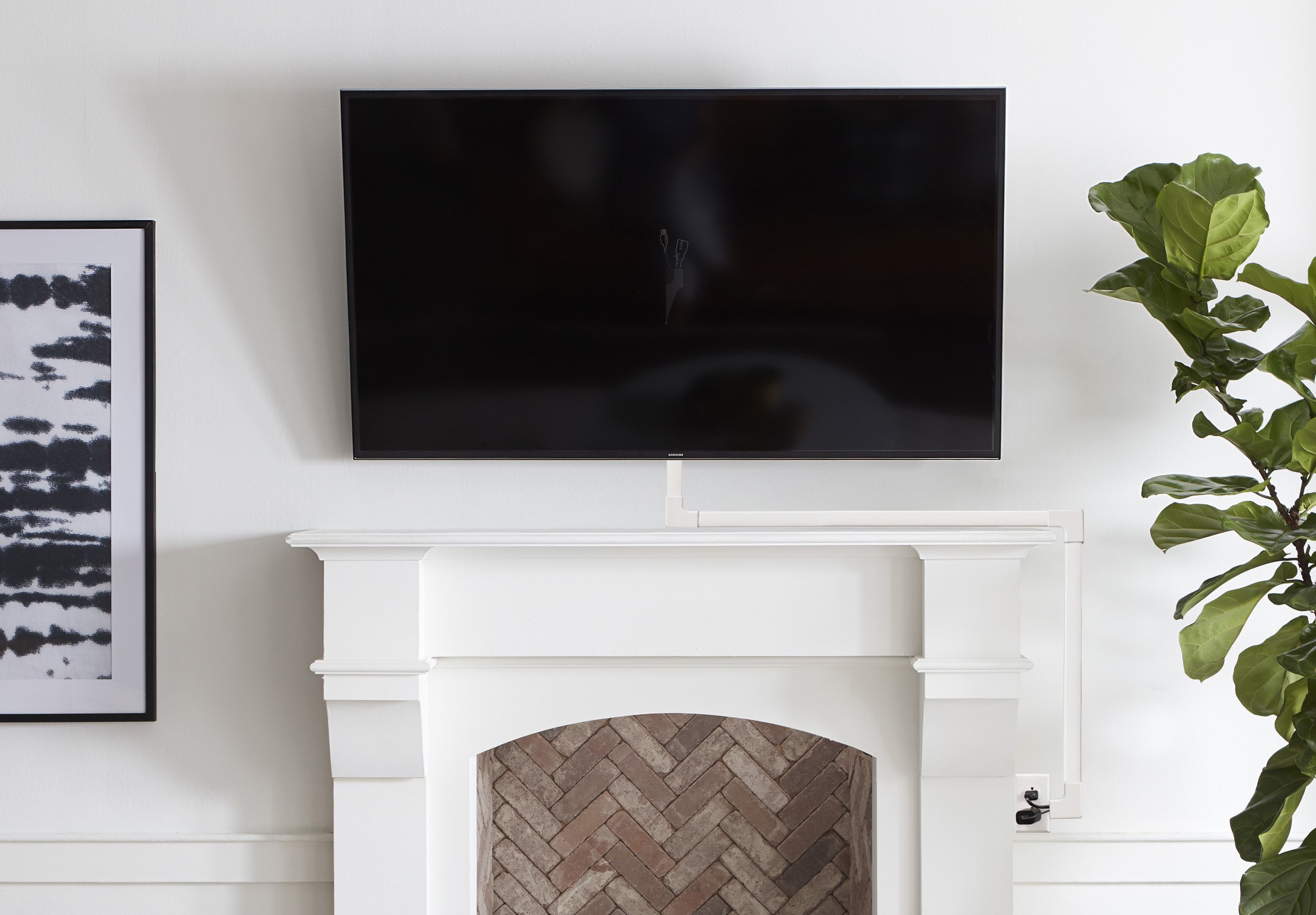
A complete TV mount install isn't just hanging a bracket. It's seven things that have to come together:
Wall and structure assessment — finding studs, identifying the wall material, checking for blocking behind drywall, and confirming the wall can support the TV
Mount selection matched to the TV's size, weight, VESA pattern, and the use case (flat, tilt, articulating, motorized, recessed, mantel)
Bracket installation with the right hardware — lag bolts into studs, toggle bolts only when the wall calls for them, never just drywall anchors for anything bigger than a 32-inch
Cable concealment — in-wall power kit, low-voltage cable runs, surge protection, and (when needed) source equipment relocation to a closet or built-in
TV mounting and leveling with a real torpedo level, not eyeballed
Source connection for streaming devices, cable boxes, soundbars, gaming consoles, and any existing equipment
Setup and basic configuration — input naming, picture mode out of "vivid" and into something that doesn't melt your eyes, and a quick walkthrough of the new setup
The three steps most installers skip: structure assessment, cable concealment, and post-install picture configuration. Those are the steps that turn a $200 craigslist mount job into a real install.
TV Mount Types and What They're For
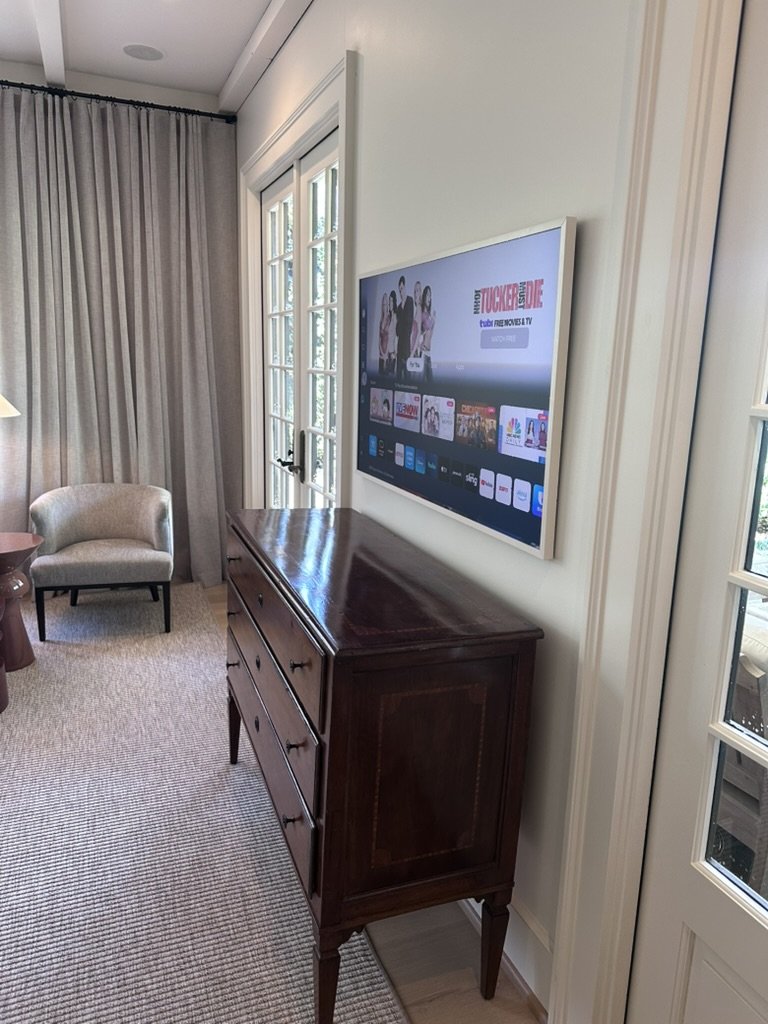
Flat mounts
TV sits flush against the wall, no movement, lowest profile. Right answer for any TV that gets viewed from straight on with seating directly in front. Cleanest look, cheapest mount, no flexibility — and that's fine for most rooms.
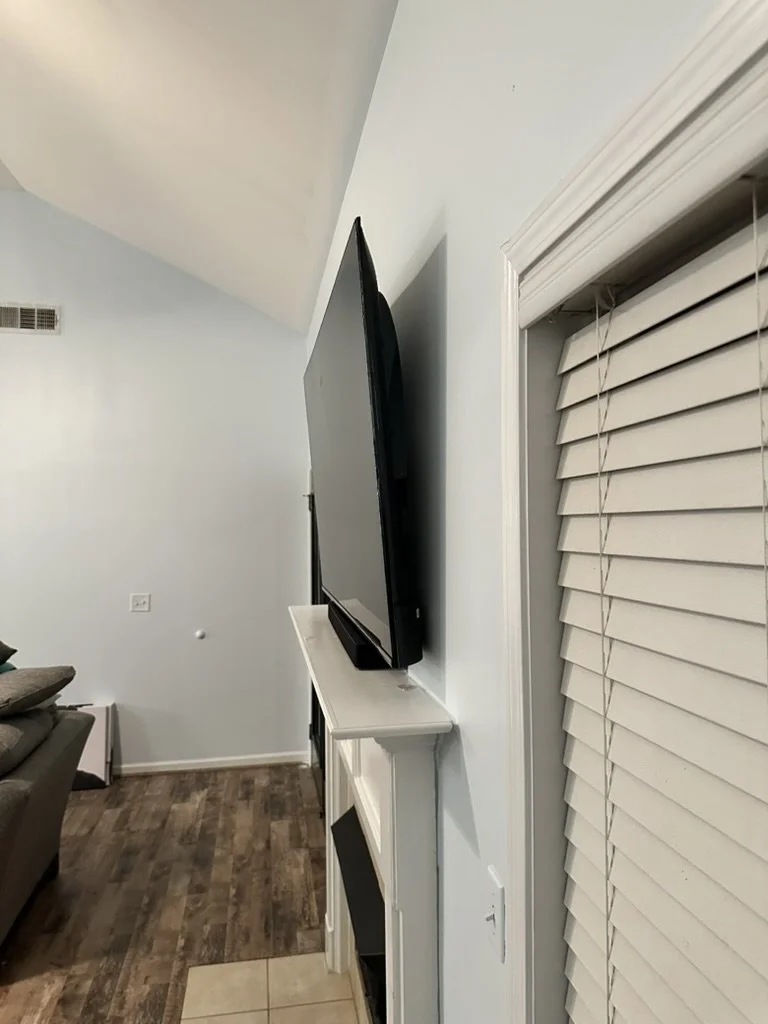
Tilting mounts
TV tilts down 5 to 15 degrees. Right answer for any TV mounted higher than the ideal eye-level — over a fireplace, in a kitchen above the cabinets, in a bedroom mounted high. Tilt corrects the viewing angle so you're not looking up at it.
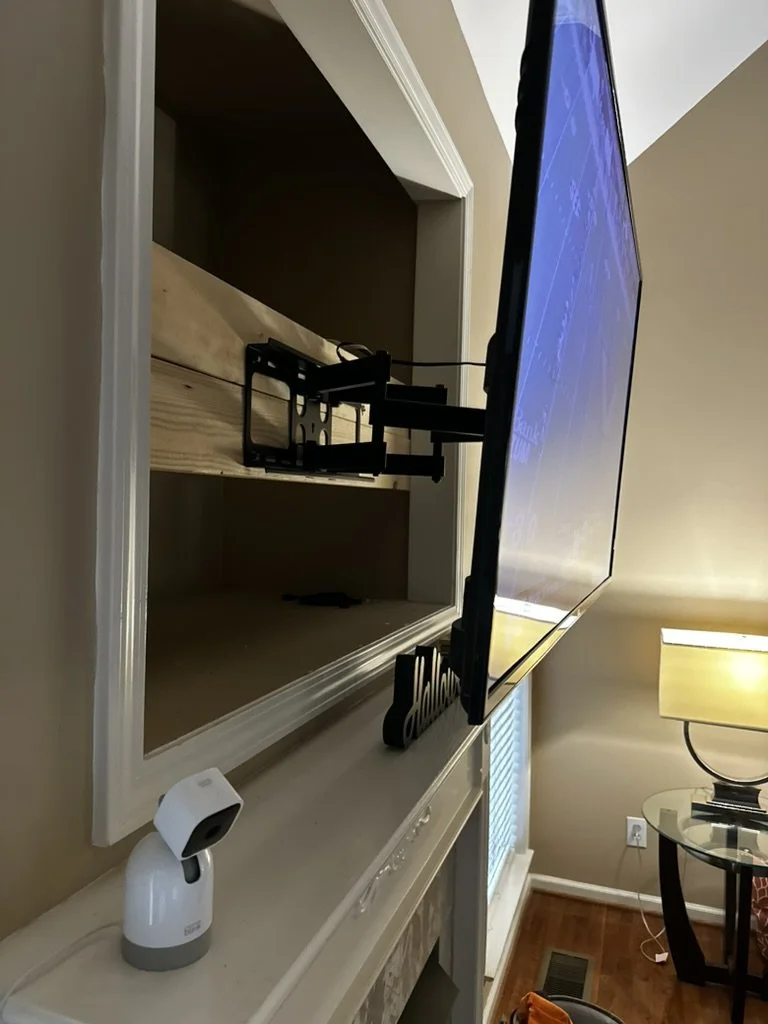
Articulating mounts (Full-Motion)
TV pulls out from the wall and swings left or right. Right answer for corner installs, kitchen TVs that need to swing toward the breakfast nook, and any room with multiple seating zones at different angles. Most articulating mounts also tilt.
Motorized mounts
TV moves on a motor — drops down from a ceiling, lifts up out of a cabinet, tilts on demand, or swings on a powered arm. Right answer for hidden installs (TV disappears when not in use), high-end media rooms with custom millwork, and any client who wants the TV to stay out of sight when the room serves another purpose. Future Automation is the brand we trust most for serious motorized installs.
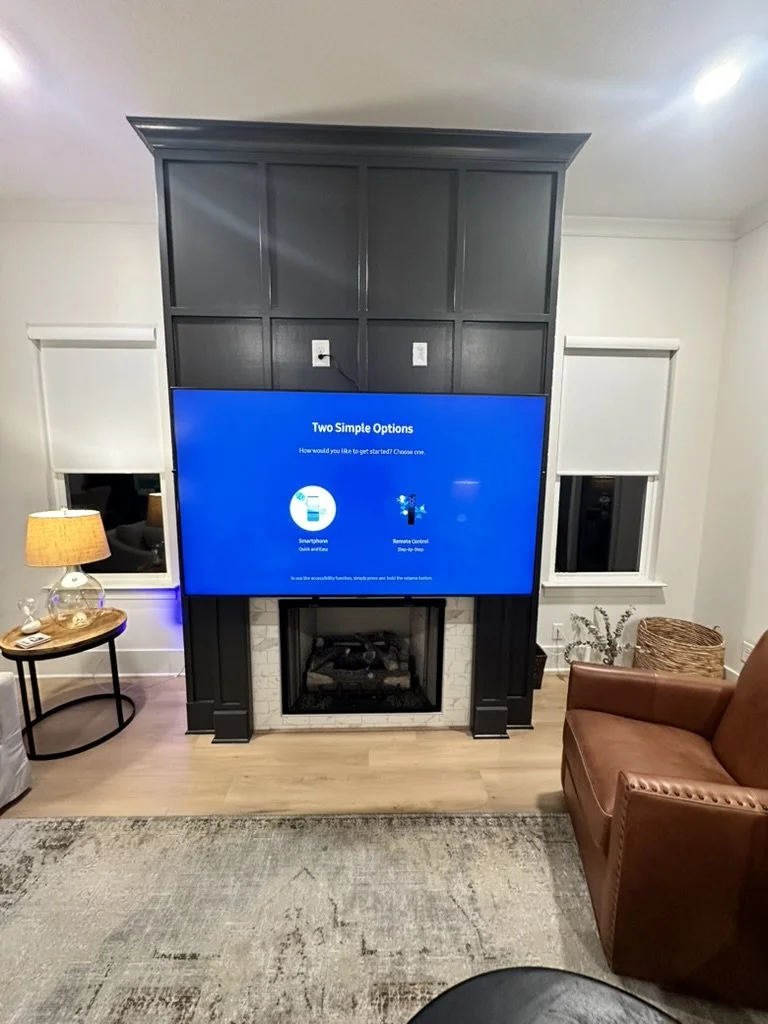
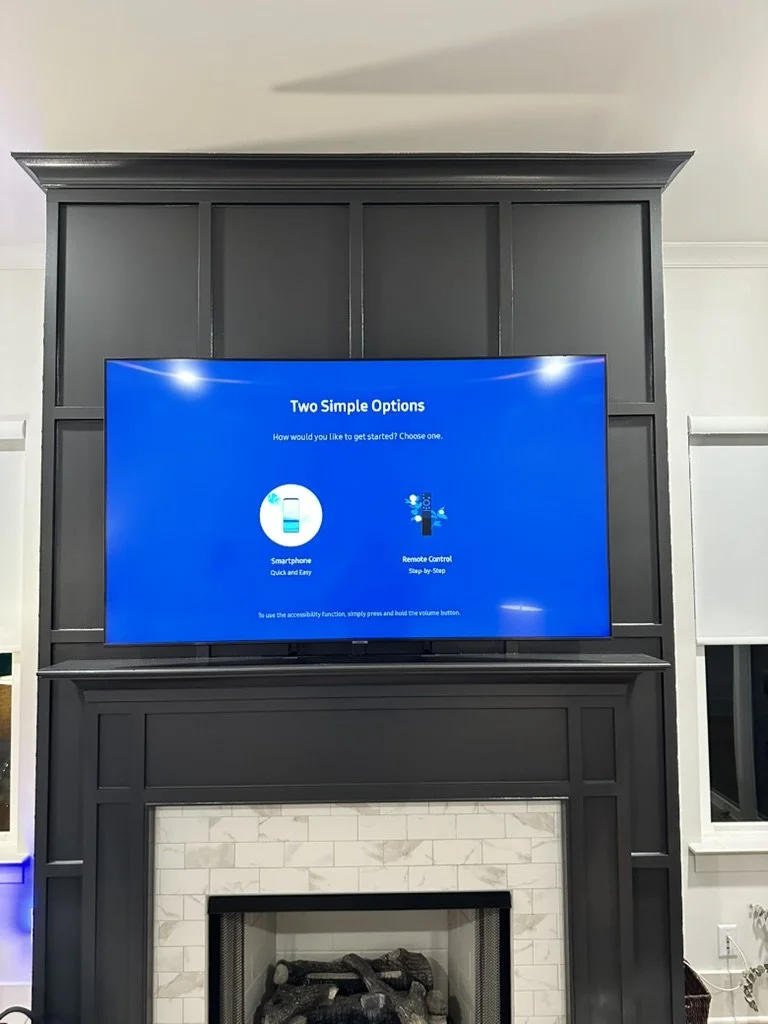
Mantel mounts
A specialty over-fireplace mount that pulls the TV down and out from the wall when in use, then folds it back flush over the mantel when off. Right answer for tall fireplace surrounds where the TV is mounted too high in its rest position. MantelMount is the brand. We cover this in detail on a dedicated fireplace TV mounting page since it's specialized enough to deserve its own page.
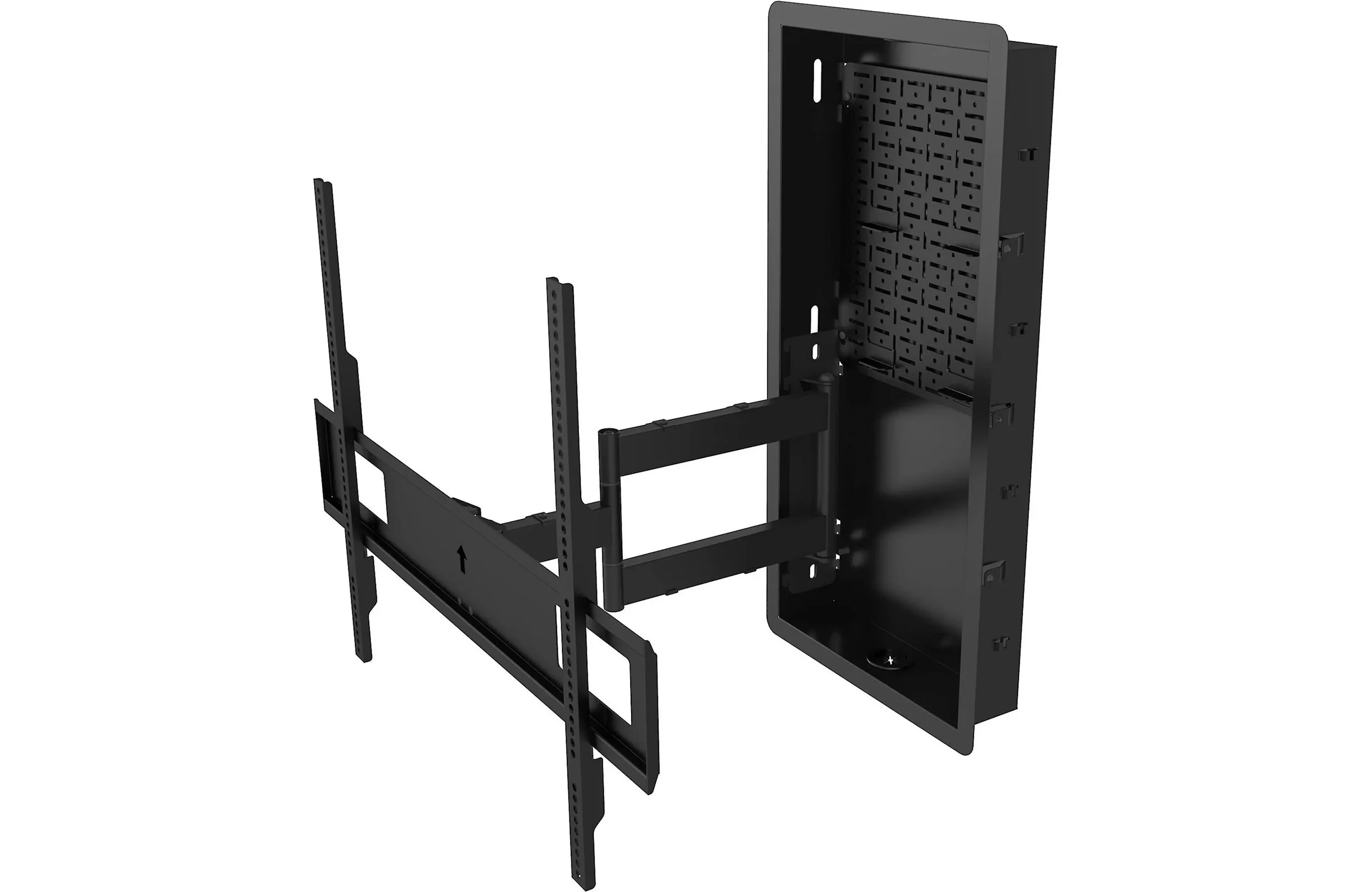
In-Wall Recessed Mounts
TV sits inside the wall in a recessed cavity, sitting flush with the surface or just slightly proud. The cleanest possible install — looks like the TV is part of the architecture. Right answer for new construction and major remodels where the wall can be opened up and a recess framed in. Common in Greystone, Liberty Park, and high-end Mountain Brook remodels.
Where TV Mounting Goes in Birmingham Homes
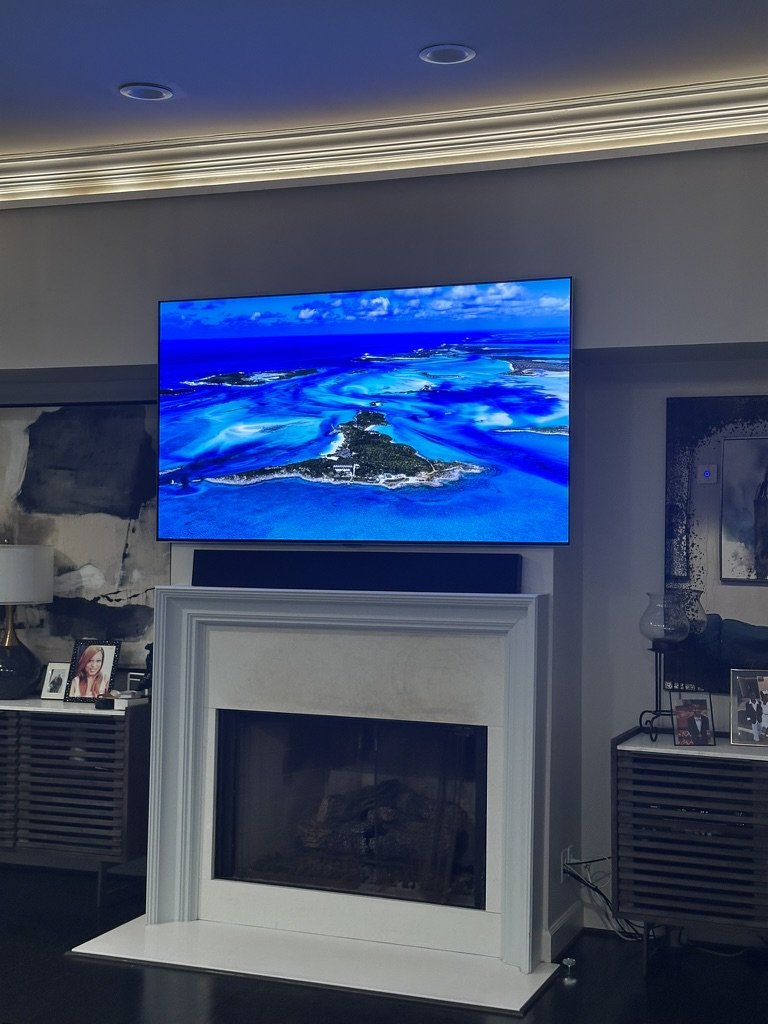
TV mounting happens in almost every room of the house at some point. The five most common scenarios:
Family rooms and great rooms. The biggest TV in the house, usually 65 to 85 inches, mounted on the primary viewing wall. Most common Birmingham TV mount.
Bedrooms. Smaller TVs, 43 to 65 inches, mounted across from the bed. The trick here is mounting height — most bedroom TVs end up too high because the bed is low. We get the height right for actual reclined viewing, not for someone standing up looking at it.
Kitchens. Small to mid-size TVs (32 to 55 inches) mounted under cabinets, in a corner, or on an articulating arm that swings toward the seating. Splash-resistant placement matters here.
Master bathrooms and exercise rooms. Specialty installs that often involve tile, stone, or moisture considerations. A TV in a Mountain Brook master bath wall isn't the same install as a TV in the family room.
Bonus rooms, basements, and game rooms. Larger TVs (75 to 98 inches) for gaming, sports, and casual viewing. Often paired with surround sound installation or a media room build.
Outdoor patios and pool decks. Outdoor-rated TVs require outdoor-rated mounts, weather-sealed cabling, and shaded placement. Covered in detail on our outdoor TV installation page since outdoor work has its own set of rules.
Over fireplaces. A category of its own — covered on the fireplace TV mounting page. The heat, the height, and the surround material all matter, and most installers get at least one of those three wrong.
Birmingham Wall Types and What They Mean for TV Mounting
This is where Birmingham actually matters. Mounting a TV in a 1950s Mountain Brook traditional is not the same job as mounting one in a 2020 Greystone build. The wall type changes the hardware, the install time, and sometimes the price.
Drywall over wood studs. The default in newer construction across Greystone, Liberty Park, Inverness, Trussville, Chelsea, and most homes built after 1980. Easiest install — find the studs, lag-bolt the bracket, mount the TV. Most TV mounts in Birmingham are this scenario.
Plaster walls with wood lath. Common in older Mountain Brook, Crestline, Forest Park, and Homewood traditional homes built before 1960. Plaster is harder to drill cleanly than drywall, the lath behind it can crack if you hit it wrong, and finding the studs takes more work because plaster blocks the magnetic stud finders. We use longer mounting hardware, work slowly, and patch any small damage on the way out.
Brick and stone fireplaces. Common across Mountain Brook, Vestavia, Crestline, Greystone, and Liberty Park. Brick and stone require masonry anchors, a hammer drill, and patience — drilling into a 100-year-old Mountain Brook fireplace stone is a one-shot situation. We mark twice, drill once, and use the right anchors for the stone type.
Tile walls. Common in master bathrooms and some kitchens. Drilling through tile cleanly takes a diamond bit and a steady hand — done wrong, the tile cracks. Done right, the TV looks like it was always supposed to be there.
Shiplap and barn wood feature walls. A growing trend in Birmingham new construction. The wood looks great but most of the boards are decorative — the actual mounting structure is the drywall or studs behind. We figure out what's load-bearing and what isn't before we drill anything.
Concrete and CMU block walls. Less common in residential, but common in finished basements and some commercial conversions. Same approach as masonry — concrete anchors, hammer drill, careful work.
If you're not sure what your walls are, we'll figure it out during the consultation.
Cable Concealment — The Step That Separates a Real Install From a Bad One
Most TV mounting jobs in Birmingham end with three or four black cables hanging down the wall to a power strip behind the entertainment console. That's not a TV install. That's a hanging hazard with a TV at the top of it.
A real install hides every cable. Three approaches depending on the situation:
In-wall power and HDMI runs (recommended). A code-compliant in-wall power kit (Echogear, Powerbridge, or Datacomm) installs a recessed receptacle behind the TV and runs the cord down inside the wall to a new outlet behind the equipment. HDMI, Ethernet, and other low-voltage cables run alongside through the same in-wall path. Looks like the TV grew from the wall.
Surface conduit. When in-wall isn't possible (concrete walls, tile installations, rentals where you can't open the wall), a slim white or black conduit hides the cables along the wall in a clean vertical line. Less invisible than in-wall, but neat and finished — far better than dangling cords.
Wireless transmission with localized power. For specific specialty applications where neither in-wall nor conduit works. Less common, more expensive, but possible.
We almost always recommend in-wall. It's about $150 to $250 more than basic mounting and it's the difference between a finished install and a half-done one.
The Install Process
Most TV mounts in Birmingham run one to four hours onsite, depending on complexity:
Simple mount (1 to 2 hours). Drywall wall, standard size TV, basic flat or tilt mount, surface conduit or no concealment. Quick job, quick out.
Standard mount with concealment (2 to 4 hours). Drywall wall, in-wall power kit, cable concealment, source equipment connection, basic setup.
Complex mount (4 to 8 hours). Brick or stone fireplace, plaster wall, large TV (85"+), articulating or motorized mount, full cable concealment, source equipment relocation, picture calibration.
Specialty mount (full day or multi-day). In-wall recessed install, motorized lift or drop-down, custom millwork integration, multi-room source distribution.
Most TV mounts in Birmingham can be scheduled within a week of a phone call. Specialty installs that need parts ordered (motorized mounts, recessed kits, custom mantels) typically take 2 to 4 weeks.
What TV Mounting Costs in Birmingham
Real ranges, mount and labor:
Basic mount: $149 to $249. TVs under 65 inches, drywall wall, flat or tilt mount, no concealment or surface conduit only. Quick install.
Standard mount with concealment: $300 to $500. Drywall wall, in-wall power kit, full cable concealment, source equipment connection. The most common Birmingham TV mount.
Complex mount: $500 to $800. Large TVs (75 to 98 inches), brick or stone walls, plaster walls, articulating mounts, fireplace installs, full cable concealment with source relocation.
Specialty mount: $600 to $1500+. Motorized mounts (Future Automation), in-wall recessed installs, MantelMount systems, multi-room TV deployment, custom millwork integration.
These numbers cover the mount, the hardware, the cabling, and the install. They don't cover the TV itself or any electrical work that requires a licensed electrician (running new circuits, modifying the breaker panel, etc.). For most installs, no electrical work is needed — we use code-compliant in-wall power kits that don't require new wiring.
FAQs About TV Mounting in Birmingham
Can you mount a TV over my brick fireplace?
Almost always yes. We've mounted TVs over brick fireplaces in Mountain Brook, Crestline, Vestavia, and Greystone. The two things to watch are heat from the fireplace (gas fireplaces especially run hot enough to damage TVs over time) and the mounting height — most fireplace TVs end up too high. We address both, and for tricky cases we use a MantelMount that pulls the TV down to a proper viewing height.
How much does TV mounting cost in Birmingham?
A basic drywall mount with no concealment runs $300 to $600. Most of our Birmingham customers go with full cable concealment (in-wall power kit, hidden HDMI), which lands in the $500 to $1,200 range. Large TVs over fireplaces or on brick/stone run $1,000 to $2,500.
Can you mount a TV on a plaster wall?
Yes. Older Mountain Brook, Crestline, Forest Park, and Homewood homes have plaster walls, and we install in them all the time. It's slower than drywall and we patch any small drilling damage on the way out. We bring extra plaster patch.
Do I need a special mount for a 98-inch TV?
Yes. A 98-inch TV weighs 100 to 130 pounds and exceeds the rating of most consumer-grade mounts. We use heavy-duty mounts rated for the actual weight (Sanus VuePoint, Chief MSP series, Future Automation) and verify the wall structure can hold it. For brick or stone, we add additional anchoring.
Can you hide all the wires?
Yes — that's the cable concealment step. An in-wall power kit hides the TV's power cord and all the HDMI, Ethernet, and audio cables behind the wall, with everything terminating at an equipment location of your choice (closet, built-in, console). The TV ends up looking like it grew out of the wall.
Can you mount a TV outside on my patio?
Yes — but only with an outdoor-rated TV (SunBriteTV, Furrion Aurora, Samsung Terrace). Indoor TVs fail outdoors within a year or two due to humidity, heat, and direct sun. We cover outdoor TV installs in detail on our outdoor TV installation page.
What about hiding the TV completely when it's not in use?
That's the invisible A/V installation page — motorized lifts, drop-down mounts, mirror TVs, and TVs hidden behind artwork. Specialty work that we do regularly.
Do you offer same-day or next-day TV mounting in Birmingham?
Often, for simple installs. Call us and we'll tell you the soonest we can schedule.
Working With a Local Birmingham Home Theater Store
Iron City A/V is a home theater store and audio visual consultant in Birmingham. We do TV mounts the way they're supposed to be done — the right mount for the TV, the right hardware for the wall, every cable concealed, the TV at a viewing height that actually works. Local, responsive, accountable.
If you need a TV mounted in Birmingham, give us a call — most installs can be scheduled within a week, and we'll tell you up front what it costs.
Iron City A/V 1 Perimeter Park S Suite 100 N, Birmingham, AL 35243